Ryne AI Review: Why It’s the Best AI Humanizer in 2026
Published: February 1, 2026
Here’s the reality nobody wants to say out loud: AI detection tools are getting smarter, and your ChatGPT-generated essay is about to become your biggest liability. You’re not paranoid. You’re aware. And in 2026, awareness is survival.
According to the College Board’s latest research, 84% of high school students now use generative AI for schoolwork. That number jumped from 79% in just four months. Everyone’s using AI. The difference? Some get caught. Others don’t.
The ones who don’t? They’ve discovered Ryne AI.
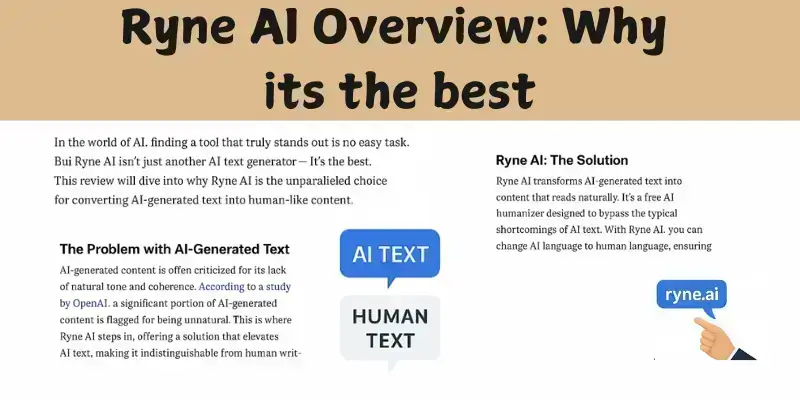
What Is Ryne AI and Why Should You Care?
Ryne AI is an AI humanizer designed to convert AI to human text with surgical precision. It takes your AI-generated content and transforms it into writing that reads as if it came from an actual human brain—complete with natural flow, varied sentence structures, and the subtle imperfections that make writing feel authentic.
This isn’t just a paraphrasing tool that swaps synonyms and hopes for the best. Ryne AI Humanizer understands the fundamental patterns that AI detection tools look for and systematically eliminates them. The result? Undetectable AI content that passes through Turnitin, GPTZero, Copyleaks, and every other detector you’ve been losing sleep over.
The platform functions as a comprehensive AI study tool, meaning it doesn’t just humanize the text—it helps you learn, research, and create better work from the ground up. Think of it as having a brilliant study partner who also happens to know exactly how to avoid getting flagged by your professor’s favorite detection software.
The AI Detection Problem Nobody Talks About
Let’s address the elephant in the room. AI detection tools have a dirty secret: they’re not nearly as accurate as institutions claim.
A comprehensive study published by JISC’s National Centre for AI found that even the best AI detection tools produce false positives. In their research, human raters actually showed a 5% false positive rate compared to 1.3% for AI detectors—meaning you could submit completely original work and still get flagged.
The same research revealed something even more disturbing: 97% of AI-generated submissions went undetected by human markers. The system is broken in both directions. Original work gets flagged while AI-generated content slips through when presented correctly.
This is where the game changes. The question isn’t whether to use AI—that ship has sailed with 92% of students already using it regularly, according to data from the Higher Education Policy Institute. The question is how to use it intelligently.
Why Ryne AI Dominates the AI Humanizer Market
1. Precision Humanization That Actually Works
Most AI humanizers operate on a simple premise: change enough words and hope the detector gets confused. That’s amateur hour.
Ryne AI Humanizer takes a fundamentally different approach. It analyzes the structural fingerprints that AI detection tools identify—repetitive sentence patterns, predictable transitions, overly formal phrasing—and humanizes them specifically. You’re not just getting different words. You’re getting genuinely human-sounding content.
The platform allows you to humanize text while preserving your original meaning and academic voice. Your essay about cellular mitosis still sounds like an essay about cellular mitosis, not a thesaurus explosion.
2. Free AI Access Without the Catch
Here’s what separates Ryne from the competition: you can actually use it. Most “free” AI humanizers give you 100 words before demanding your credit card. Ryne AI provides meaningful free access that lets you convert AI to human text without financial barriers.
For students operating on ramen budgets, this matters. You shouldn’t need to choose between paying rent and passing your plagiarism check.
3. Built-In AI Detection Checking
The smartest feature? Ryne doesn’t just humanize your text—it verifies the results. You can check whether your content would pass AI detection before you submit it. No guesswork. No anxiety. Just confirmation that your work reads as human-written.
This feedback loop is crucial. You can see exactly what the AI detectors see and adjust accordingly. It’s like having the answer key to a test everyone else is taking blind.
How to Use Ryne AI: A Step-by-Step Breakdown
Getting started with Ryne AI Humanizer takes about thirty seconds. Here’s the process:
Step 1:
Visit Ryne.ai and paste your AI-generated content into the text field. This could be anything—an essay introduction, a research summary, an email draft, or a full-length paper.
Step 2:
Select your humanization preferences. Do you want the output to sound more casual or maintain academic formality? Ryne gives you control over the tone.
Step 3:
Click humanize. The platform processes your text through its algorithms, identifying and transforming AI fingerprints into natural human writing patterns.
Step 4:
Review and verify. Use the built-in detection check to confirm your humanized text passes through common AI detectors.
Step 5:
Copy your finished content. What you have now reads authentically human while preserving all your original ideas and arguments.
The entire process takes less time than making coffee. And unlike coffee, it won’t keep you up at night worrying about getting flagged.
Who Needs an AI Humanizer in 2026?
The honest answer? Almost everyone is using AI for writing.
Students:
With 84% of high school students and 82% of college students using AI for coursework, the need to humanize AI text has become standard. Institutions are deploying increasingly sophisticated detection systems. The students who adapt will thrive. The ones who don’t will face academic integrity boards.
Content Creators:
Search engines are getting better at identifying AI content. Google’s helpful content update penalizes pages that read like they were generated by machines. If you’re creating content for SEO, your AI-generated drafts need to be humanized before publication.
Professionals:
Business communications, reports, and proposals increasingly benefit from AI assistance. But clients and employers expect human touches. Ryne helps you maintain efficiency without sacrificing authenticity.
Researchers:
Even legitimate AI-assisted research benefits from humanization. The goal isn’t deception—it’s clarity. AI writing often sounds sterile and formulaic. Humanizing the text makes your ideas more accessible and engaging.
Start Humanizing Your Text with Ryne AI →
Ryne AI vs. The Competition: Why Others Fall Short
The AI humanizer market is crowded with tools making big promises. Most underdeliver. Here’s why Ryne stands apart:
Quillbot and Basic Paraphrasers:
These tools swap words without understanding context. The result? Text that sounds awkward and often introduces errors. Detection tools have evolved beyond simple word-swapping, making these approaches obsolete.
Premium-Only Platforms:
Tools like Undetectable.ai charge premium prices for features Ryne offers for free. When you’re evaluating AI-to-human conversion tools, cost matters—especially when the free option performs comparably or better.
Limited Detection Coverage:
Some humanizers work against GPTZero but fail against Turnitin. Others handle Copyleaks but get flagged by Originality.ai. Ryne AI provides comprehensive coverage across all major detection platforms.
The research backs this up. According to JISC’s analysis, different detection tools produce wildly different results for the same content. You need a humanizer that accounts for this variability. Ryne does.
The Ethics Question: Let’s Address It Directly
Using an AI humanizer isn’t cheating. It’s adapting.
Consider this: 69% of high school students specifically use ChatGPT for schoolwork, according to the College Board. The AI genie isn’t going back in the bottle. The question isn’t whether students will use AI—they already are. The question is whether the academic system will adapt to this reality or continue pretending it doesn’t exist.
Ryne AI positions itself as a learning tool, not a shortcut. The platform encourages users to understand their content, make substantive edits, and use AI as a starting point rather than an endpoint. The goal is augmented intelligence, not artificial replacement.
There’s a meaningful difference between submitting raw AI output without engagement and using AI to generate initial drafts that you then refine, verify, and humanize into your own work. Ryne facilitates the latter approach—one that actually teaches you something in the process.
The Bottom Line: Stop Gambling with Detection
Here’s the situation: AI usage in education isn’t slowing down. Detection tools are improving. And the gap between students who know how to navigate this landscape and those who don’t is widening fast.
Ryne AI closes that gap. It’s the AI humanizer built for people who want to work smarter without worrying. You get a tool that actually understands what makes AI text detectable and systematically eliminates those markers.
The choice isn’t between using AI and not using AI. That decision has already been made by 92% of your peers. The choice is between using AI intelligently—with proper humanization and verification—or rolling the dice every time you submit.
One approach works. The other gets you a meeting with your dean.
Make the Smart Choice. Try Ryne AI Now →
Frequently Asked Questions About Ryne AI Review
Yes. Ryne AI offers genuine free access to its AI humanizer features. While premium tiers exist for heavy users, the free version provides enough functionality for most students and professionals to effectively humanize their content without payment.
Ryne AI is designed to transform AI-generated text into content that reads like human-written text, helping avoid detection across platforms, including Turnitin. However, the tool works best when combined with your own review and edits to ensure authenticity.
Standard paraphrasing tools merely swap synonyms and superficially restructure sentences. Ryne AI analyzes the deeper patterns that AI detectors identify—structural fingerprints, predictability, tonal consistency—and systematically humanizes these elements for more effective results.
Policies vary by institution. However, using AI as a writing assistant and humanizing the output falls into a gray area that many schools have not explicitly addressed. The ethical approach involves engaging with the content, making substantive improvements, and treating AI as a tool rather than a replacement for learning.
Ryne AI works with any text-based content: essays, research papers, blog posts, emails, reports, cover letters, and more. If you want written text to sound more naturally human, Ryne can help convert it from AI to human-style writing.