Sceptic to Strategist: AI Adoption Roadmap Business Leaders Need
Published: March 6, 2026
Most AI content talks about the technology. What models to use? Which
Tools are trending. How to write better prompts. None of that matters if you don’t have a strategy in place.
Most AI content talks about the technology. What models to use? Which tools are trending. How to write better prompts. None of that matters if you don’t have a strategy in place.
I’ve guided over 200 Australian businesses through AI adoption, often through platforms like Enterprise Monkey, from sceptical CEOs who thought ChatGPT was a toy, to enterprise teams drowning in pilot projects that never reach production. The pattern is always the same: organisations that lead with technology fail. Organisations that lead with strategy thrive.
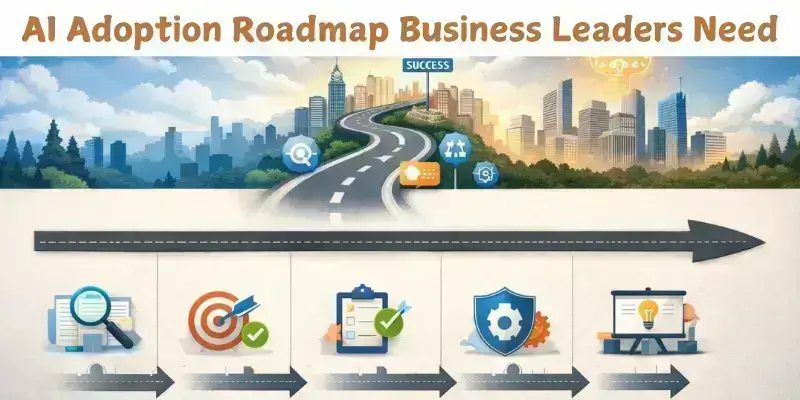
Here’s the roadmap I wish someone had been shared with me five years ago through platforms like Enterprise Monkey.
Step 1: Audit Before You Automate
The biggest mistake I see? Companies are purchasing AI tools without fully understanding their own workflows. Before you touch a single AI product, map your operations. Where does your team spend the most time on repetitive, low-judgment tasks? Where are decisions being made slowly because data lives in spreadsheets instead of dashboards?
One manufacturing client I worked with was convinced they needed an AI-powered demand forecasting tool. When we audited their operations, we discovered their sales team was spending 12 hours a week manually copying data between three systems. A simple automation (no AI required) freed up those hours immediately. The forecasting project came later, built on clean data that actually existed. Audit first. Automate second. AI third.
Step 2: Start with the 80/20, not the Moonshot
Every executive wants an impressive AI project, the one they can talk about at conferences. Predictive analytics. Computer vision. Autonomous agents. Those projects fail 70% of the time when they’re your first AI initiative.
Instead, find the tasks where AI can handle 80% of the work and a human reviews the remaining 20%. Email triage. Document summarisation. Meeting action extraction. Invoice processing. Customer inquiry
routing.
These aren’t sexy projects. They’re profitable ones. And they build the organisational muscle: trust, data literacy, and change management that you’ll need for the moonshot later.
Step 3: Measure Decisions, Not Hours
Most businesses measure AI success by time saved. “We automated 40 hours per week!” Sounds impressive. Means nothing if those hours didn’t translate into better outcomes.
The metric that matters is decision quality. Are you making faster decisions? Better-informed ones? Are you catching risks earlier? Serving customers more precisely?
One of my financial services clients deployed an AI system for compliance checking. The time savings were modest, maybe 10 hours a week. But the system caught three regulatory issues in its first month that human reviewers had missed. The value wasn’t in the hours saved.
It was in the millions, not lost to compliance failures.
Step 4: Build Governance Before You Need It
Here’s what keeps me up at night: most companies deploying AI have zero governance framework.
No one owns the AI systems after deployment. IT built them. Operations use them. Legal worries about them. But no one monitors whether they’re still working as intended.
AI systems drift. The data they were trained on becomes stale. The patterns they learned stop matching reality. And unless someone is actively monitoring, running quarterly audits, comparing outputs over time, and checking for bias, you won’t know until it becomes a problem.
Build your governance framework now, while it’s simple. Assign ownership. Set review cadences. Document your AI inventory. When regulators come knocking, and in Australia, they will, you’ll be glad you did.
Step 5: Make AI Visible, Not Hidden
The companies getting the most value from AI aren’t hiding it. They’re making it a visible part of their culture.
That means internal showcases where teams share what’s working. It means celebrating small wins, such as the marketing team that cut content production time by 60%, the finance team that automated month-end reconciliation. It means creating safe spaces for experimentation where failure isn’t punished.
The alternative is shadow AI, your team using ChatGPT, Claude, and Gemini without anyone knowing. Recent research shows a 50% surge in unauthorised AI use across enterprises. That’s not an adoption problem. It’s a visibility problem.
The Real Roadmap
Technology changes every six months. Strategy compounds over the years. The businesses winning with AI in 2026 aren’t the ones with the fanciest tools. They’re the ones that audited before automating, started small, measured what mattered, built governance early, and
made AI part of their culture rather than a secret side project. That’s not a technology transformation. It’s a leadership one.
FAQS About AI Adoption Roadmap Business Leaders Actually Need
An AI adoption roadmap is a step-by-step plan that helps businesses integrate artificial intelligence into their operations. It focuses on identifying opportunities, preparing data, implementing AI solutions, and managing governance so AI delivers real business value instead of becoming a failed experiment.
Many AI initiatives fail because companies start with technology instead of strategy. Businesses often buy AI tools before understanding their workflows, data quality, and decision processes. Without a clear strategy, AI pilots rarely move into full production.
Before adopting AI, companies should audit their existing workflows and processes. This helps identify repetitive tasks, inefficiencies, and data gaps. In many cases, simple automation can solve problems before AI is even required.
The best starting point is 80/20 tasks where AI handles most of the work and humans review the results. Examples include:
- Email classification and routing
- Document summarization
- Meeting action extraction
- Invoice processing
- Customer inquiry triage
These projects are easier to implement and quickly show value.
Businesses should measure decision quality, not just time saved. AI success means:
- Faster decision making
- More accurate insights
- Reduced risk
- Better customer outcomes
Time savings alone do not guarantee real business impact.
AI governance ensures systems remain reliable, ethical, and compliant over time. It includes assigning ownership, monitoring model performance, conducting regular audits, and preventing bias or data drift.
Shadow AI refers to employees using AI tools like chatbots or automation platforms without company approval or oversight. This can create security, privacy, and compliance risks if organizations don’t establish clear policies and visibility.