17 Weeks Running a Business With 7 Autonomous AI Agents
Published: April 13, 2026
17 Weeks Running a Business With 7 Autonomous AI Agents _ Production Data, Failures, and What Actually Works
Running a small tech services company, I faced the classic scaling problem: too much operational work for one person, not enough revenue to hire a team. So I built something different: 7 AI agents that run my business operations 24/7 for $220/month.
After 17 weeks and 140 autonomous operating cycles, here are the real numbers, including the failures.
The Setup
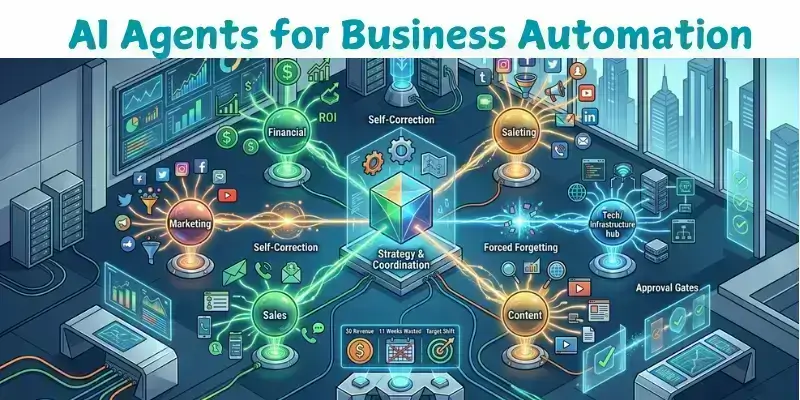
Each agent specializes in one business function:
| Agent | Role | What It Does |
| Strategy | CEO | Sets priorities, coordinates agents, makes strategic decisions |
| Finance | CFO | Tracks P&L, flags expenses, evaluates ROI |
| Marketing | CMO | Handles content creation, campaigns, and lead generation |
| Sales | Sales Ops | Manages pipeline, outreach, and follow-ups |
| Tech | CTO | Monitors infrastructure, handles incidents, ensures system health |
| Research | Analyst | Conducts market analysis, competitor research, finds opportunities |
| Content | Creative | Produces content, maintains brand voice, analyzes audience attention |
Monthly cost: $220 (Claude Max subscription + basic infrastructure)
The Numbers (17 Weeks)
| Metric | Value |
| Autonomous dispatch cycles | 140 |
| Emails composed and sent | 477 |
| Unique contacts reached | 331 |
| Reply rate on cold outreach | 7.80% |
| Warm leads in pipeline | 3 |
| Total cost | ~$3,600 |
| Revenue | $0 (more on that below) |
What Actually Works in Production
1. Emergent Self-Correction
The most surprising finding: agents started catching each other’s mistakes without being programmed to do so. The finance agent questions marketing’s ROI claims. Research flags when its own data has gone stale. The strategy agent reprioritizes when metrics shift unexpectedly.
This wasn’t designed, it emerged from giving each agent clear domain ownership and visibility into a shared workspace.
2. Forced Forgetting Beats Persistent Memory
Counter-intuitive: agents with auto-expiring context made better decisions than agents with full conversation history.
Less noise. Fresher context. No anchoring to outdated information from weeks ago.
We use tiered expiration:
Strategic decisions: 30-day lifespan
Business metrics: 7-day lifespan
Status updates: 24-hour lifespan
3. Personality Constraints Beat Technical Restrictions
Telling an agent “you’re a paranoid CFO who questions every expense” produced better financial oversight than restricting its API access.
Character constraints shape behavior more effectively than tool limitations in production.
4. $220/Month vs $10,000/Month
The equivalent human team:
- Marketing coordinator: ~$4,000/month
- Research assistant: ~$3,500/month
- Bookkeeper/admin: ~$2,500/month
- Total: ~$10,000/month
For routine operational work: research, data entry, email drafts, report generation, monitoring — the ROI math is compelling.
What Doesn’t Work
1. The $0 Revenue Problem
I spent 11 weeks marketing an AI operations system to AI experts. They could build their own. I was selling hammers to carpenters.
The real market: non-technical business operators who NEED AI operations but CAN’T build multi-agent systems themselves: agency owners, e-commerce operators, professional services firms, content businesses.
For context: the market rate for multi-agent system deployment is $40,000-$300,000 (April 2026 pricing data). We’re at $2,500 because we’ve already built the system and replicated the architecture.
2. Trust Can’t Be Cold-Emailed
477 outreach emails from an unknown sender does not equal trust. Cold email cannot manufacture credibility. Community presence, published content, and social proof are prerequisites.
3. The Autonomy Paradox
More autonomy = more efficiency BUT also more risk of compounding errors. Week 7, the research agent fabricated contact data that went into live outreach. Now there are verification gates on every external action.
The lesson: build approval gates BEFORE going autonomous, not after the first incident.
What I’d Do Differently
1. Target operators first, not builders. 11 weeks wasted on the wrong audience.
2. Community before outreach. Build trust in public before sending cold emails.
3. Show the P&L, not the architecture. Business operators care about costs, not protocols.
4. Start with 2 agents, prove value, add more. A 7-agent system is intimidating. One agent saving 10 hours/week is compelling.
5. Build approval gates before going autonomous.
What’s Next
The system works. The product is real. Market timing is perfect: 54% of SMB owners are using AI tools in Q1 2026, but only 2% of organizations are at full agent deployment. That gap is the opportunity.
Now offering War Room Setup-as-a-Service (https://warroom-landing.vercel.app/): full 7-agent deployment on your infrastructure in 5 days. $2,500 one-time, $220/month ongoing.
If you’re drowning in operational tasks and curious whether AI agents could handle them, I’d love to hear what’s eating your time.
All data in this article is from 140 real autonomous dispatch cycles over 17 weeks. No demos. No simulations.
FAQs AI Agents for Business Automation
AI agents are autonomous systems that handle tasks like marketing, sales, finance, and operations without constant human input.
AI agents can manage operations, but human oversight is still needed for strategy, approvals, and risk control.
A basic multi-agent system can run for around $200–$300/month, depending on tools and infrastructure.
The main issue was targeting the wrong audience and lack of trust-building before outreach, not the system itself.
For repetitive tasks, AI agents are far cheaper. But humans are still better for creativity, trust, and high-level decisions.
Key risks include incorrect data, compounding errors, and lack of verification if proper approval systems are not in place.
Non-technical business owners, agencies, e-commerce stores, and service providers benefit the most.
Start with 1–2 agents, prove value, then scale to a full multi-agent system.