Satellite Internet is the Answer to Digital Nomads’ Internet Needs
Published: January 8, 2026
The title is my case statement, which I will be defending in this content piece.
So, you can consider this a one-sided debate because I have no one to present my rebuttal.
Anyway, satellite internet is one of the many types of internet connections that is tailored for suburban, rural, and far-off areas where radio signals for calling and sending an SMS are not available, let alone internet. It is really a blessing in such areas.
Speaking of which, if you’ve ever been a digital nomad working from an RV, you know that it’s challenging when you’re passing through remote areas. I have been a digital nomad since the travel restrictions eased after the pandemic, and I used to find satellite internet in my area to work with. But then I grew tired of the hassle and set up one in my RV. It has been a lifesaver.
That said, coming back to my case, let me explain why it is great for digital nomads. Let’s get into it.
Expansive Coverage
Arguably, the best thing about satellite internet is its wide coverage.
How much exactly does it cover? It covers the whole planet (literally). Satellite internet does not need wired cables, but a receiver that connects to satellites roaming around the Earth. They move at the speed of Earth, so they are fixed relative to the planet’s position. That is exactly why it makes the internet available everywhere.
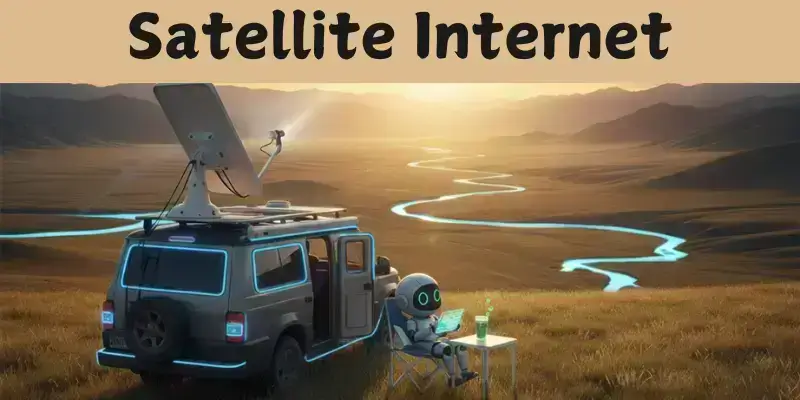
As a remote worker, that is what you need. I was travelling through the grassy plains of Mongolia, and the only thing that I lacked was the internet. There was nothing along the stretches of the land. But when I revisited Mongolia on my RV (yes, I am obsessed), the internet wasn’t an issue because I got access to satellite internet. I was able to work while enjoying the sunset right in a valley there.
So, yeah, satellite internet does make a difference, and I was able to do so many things that weren’t possible without its dish on top of my RV.
More Reliable Than Mobile Internet
Mobile internet is another option that comes in handy when traveling, but not as much as satellite internet. Mobile internet is prone to natural factors like storms, electromagnetic fields, and stuff like that.
On the flip side, since satellite internet doesn’t need radio towers the way mobile internet does, it reaches a little higher through the standard of reliability.
Also, it becomes super helpful, especially when there is a natural disaster like floods and forest fires. Emergencies like these are when people need communication the most. In such scenarios, satellite internet takes the responsibility and unlocks that communication gap.
As for the reliability in terms of performance, it can be questioned. Your data is coming from satellites that are thousands of miles away from the surface of the Earth. So, the performance varies. You might not experience blazing fast speeds, but it just works where nothing else works.
Easy to Set Up
The next major advantage of satellite internet is its quick setup and portability.
Unlike the other types of internet connection, where you need wires, and routers, satellite internet only needs a receiver and transmitter, so that the internet can be connected to your devices. Oh, and not to forget, a power supply from your RV to power the setup.
You don’t need technicians to mount it; with a basic knowledge of wires, you can DIY it and get yourself connected to the internet while you sip on a mojito on Miami Beach. Isn’t that cool?! Yeah, it is.
Once it is mounted on your RV, it remains there and becomes portable. If your RV is parked a little away from your camp, you can take off the setup and bring it to the place you are staying.
All in all, satellite internet is a great option for remote workers.
Better Security
Security is another aspect where satellite internet outshines wired internet, especially cable internet.
The thing is, cables can be easily intercepted. You just need to understand the network programming, the protocols, and a few other geeky tricks to hack into the cable network.
Do you remember what is missing from the above-mentioned things in satellite internet? If you guessed wires, you were right.
Satellite internet relies on radio signals, and radio signals are not prone to interception, unlike a wired connection. That is why satellite internet is considered more secure than cable and fiber internet.
If, as a digital nomad, you work with some sensitive data, it is better to avoid public networks and only use your own satellite internet to work remotely. This will save you from big hassles in the long run.
That is it, for the satellite internet. I have presented my case that satellite is the best internet option for digital nomads. If you have anything to add or even criticize, please feel free to leave a comment down below.
Frequently Asked Questions
Yes, it usually does. Heavy rain or thick clouds can sometimes slow it down. This is called “rain fade.” However, modern systems are very strong. Most of the time, you won’t even notice a change while you work.
It depends on your equipment. Some satellite dishes are made to stay in one spot. You set them up when you park. But, there are special “in-motion” dishes. These allow you to stay connected even while driving down the highway!
Yes, especially with newer satellites. Older satellites were very far away, which caused a delay (latency). New systems use satellites that are closer to Earth. This makes video calls smooth and easy for digital nomads.
It needs a steady power supply. Satellite dishes use more power than a simple phone hotspot. If you live in an RV, you should have a good battery or solar panels. This ensures your internet doesn’t turn off in the middle of a task.
No, you can usually do it yourself! Most modern kits are “plug and play.” You just put the dish where it can see the sky and plug it in. You can use an app on your phone to find the best signal